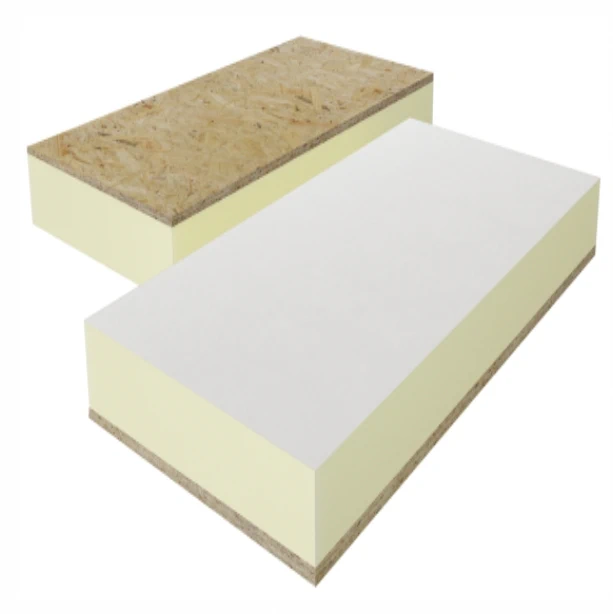
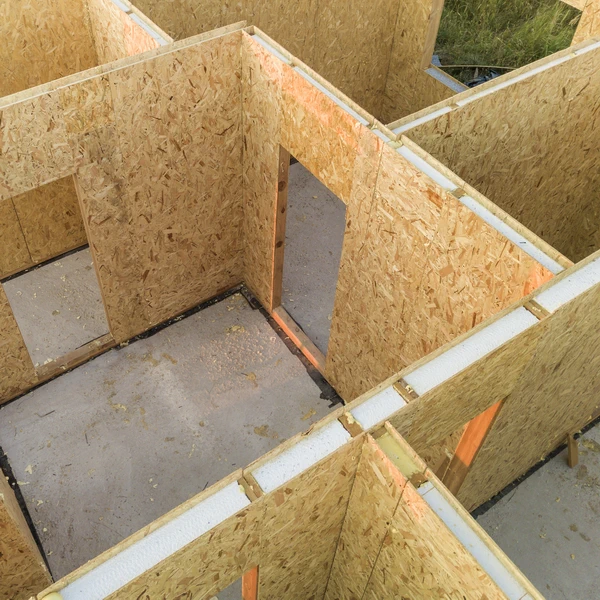
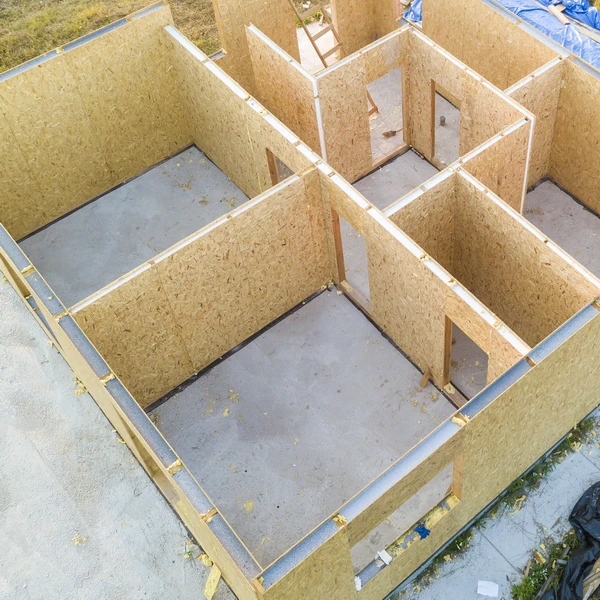
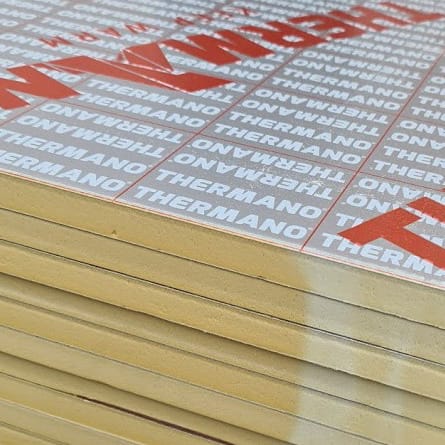
PIR–OSB SIP panel
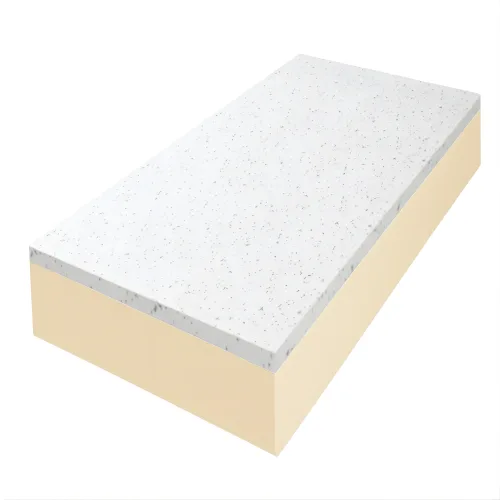
PIR core: 20 mm; OSB facing: 1 × 8 mm
Polyisocyanurate (PIR) insulation
SIP panels made to order
Available PIR core thicknesses: 20–200 mm
Available OSB board thicknesses: 8, 10, 12, 18 and 22 mm
Panel width: 1,200 mm
Panel length: 2,500 mm
Area per panel: 3.00 m²
Sales unit: one panel
Gas-tight facing: aluminium-laminated paper plus OSB board
Grade: first grade
Declared thermal conductivity λ: 0.022 W/(m·K)
SIP composite panel termPIR AL — 1 × 8 mm OSB and 20 mm PIR
21,35 € incl. VAT
In stock
In stock
Description
SIP panels
Combining insulation with a wood-based board creates practical options for lightweight construction. SIP panels with a PIR core and OSB facing allow a bonded component to be handled instead of fitting every layer separately. They provide a basis for assemblies requiring a compact build-up, consistent formats and efficient work.
Facing and insulation in a shared format
OSB is bonded to the insulating core, keeping both materials within the same geometry. This helps plan construction fields and their positions relative to the structure. Separate insulation and sheathing do not need to be matched at every step. One-sided or two-sided facings allow the arrangement to suit the design. This is convenient across repeated areas where uniform thickness and clear joint positions matter.
PIR helps keep the build-up compact
The foam core limits heat conduction, and its insulation performance helps use space within the assembly efficiently. This matters in refurbishments where new work must fit between existing components. The foam itself adds relatively little weight to the bonded panel. Selecting the core thickness links thermal performance to the overall element dimensions. It helps plan junctions at reveals, edges and changes of direction where bulky layers can complicate finishing.
OSB as a practical working surface
The wood-based board provides a firm facing that can be worked with suitable woodworking tools. Planned cuts allow the panel to fit the assembly outline. Within an application allowed for the product, OSB can support further layers, offering more finishing options than an exposed insulation core. Planning panel joints in advance helps establish edge support, structural connections and corner closures. On simple construction fields, large formats reduce separately positioned pieces and help create a plane that joins the other room surfaces.
Repeated components in an individual arrangement
Panels can be used in lightweight building arrangements intended for the specific product. A regular format helps develop repeated details, and selectable OSB and PIR thicknesses match the element to its task. Not every product called SIP is a self-supporting structural panel: capacity and supports follow from the documentation. Correct selection can combine sheathing and insulation work, reducing operations at each section and keeping the overall arrangement organised.
SteelProfil supplies SIP panels to order alongside a wide selection of stocked building materials. The overall range includes first- and second-grade products, promotions and favourable prices. Explore the PIR and OSB combinations and choose a layer arrangement suited to the proposed lightweight construction.
Related products
-

Materials for construction, refurbishment and finishing.
Operated by SteelProfil sp. z o.o.