
Roofs and roof coverings
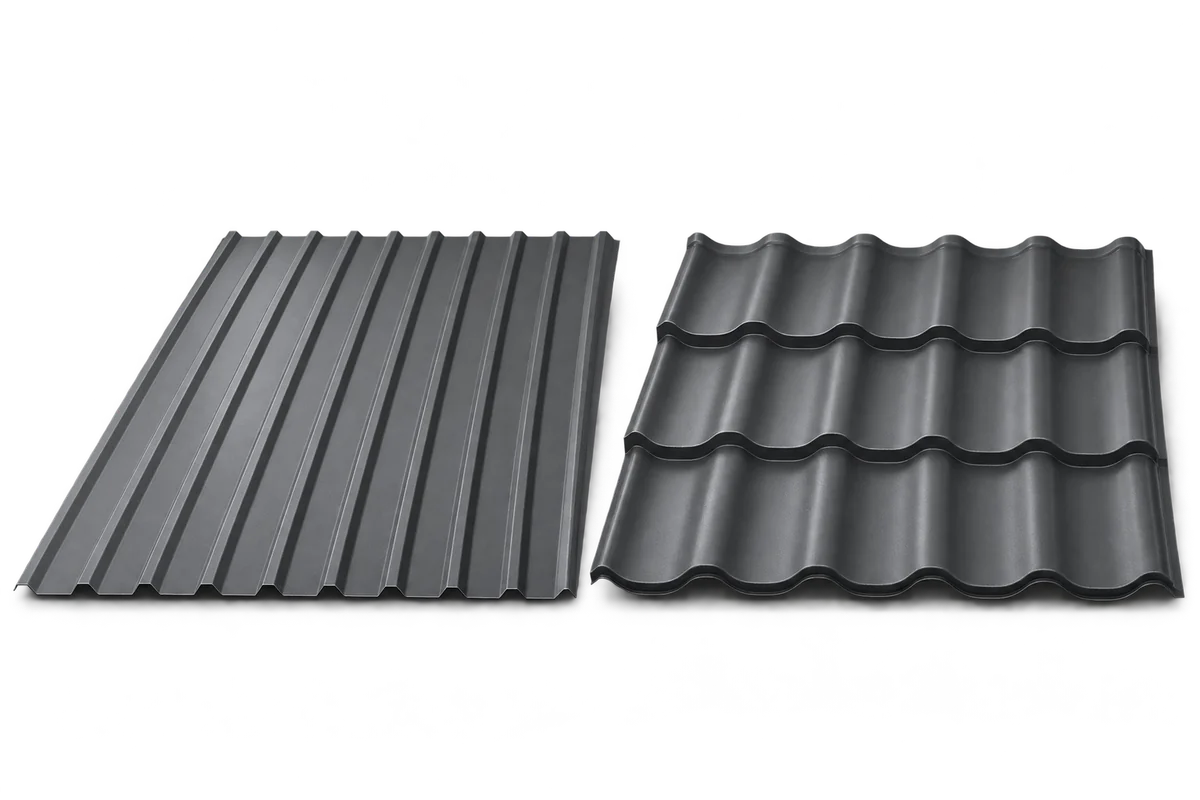
Metal roof tiles suit traditional houses, while trapezoidal sheets create a simpler roofline. Check the roof pitch, support spacing, protective coating and total installed cost alongside the appearance. Compare T18 and T35 profiles, cut-to-length sheets and modular panels against the same roof plan. Tile-profile sheets form regular rows like traditional roof tiles. They work particularly well with pronounced eaves, dormers or a traditional façade. Modular metal tiles come in small panels, while a cut-to-length sheet can cover a larger part of a roof slope in one piece.
In this guide
Which profile suits the building?
Both types need flashings that match the profile geometry.
Trapezoidal sheeting gives the roof continuous lines from ridge to eaves. T18 is often considered for smaller buildings, garages and canopies. T35 has deeper ribs and may suit a different support arrangement. Load capacity also depends on the sheet and its installation. On a house, check how the profile fits the building’s proportions, how deep it looks at the eaves and how it meets the gutter.
Check roof pitch and support spacing first
The manufacturer specifies the permissible pitch for each profile. Different metal tile systems and different T18 sheets can have different limits. Requirements may depend on end laps and the sealing method. Extra screws or an improvised sealing tape cannot compensate for a roof pitch outside the specified range.
The designer checks snow and wind loads and the supporting structure. The sheet must carry the design loads within its resistance and deflection limits. Use a load table for the actual sheet thickness, steel grade and profile orientation. When replacing a roof covering, inspect the existing structure even if the new sheets are lightweight.
Long sheets or smaller modules?
On a simple roof slope, long sheets cut to length reduce the number of end laps. Plan the transport, unloading area and lift to roof level. Thin sheets can distort if carried without adequate support. Check the dimensions on site before ordering because the completed roof may differ from an old drawing.
Modules are easier to store and handle around valleys, dormers and short roof sections. Calculate the waste from a cutting plan, taking account of whether offcuts can be reused and how the pattern must be laid. Compare two material schedules for the same roof. A small module can also make a local repair easier, provided a matching profile and colour are still available when needed.
What does the protective coating do?
Sheets in the same graphite shade may have different metallic and organic coatings. Check the type of protection, declared properties and intended environment in the product data sheet. Paint film thickness is stated in micrometres. Zinc coating mass is stated in grams per square metre.
Coastal, industrial and agricultural environments may need a different corrosion protection system from a sheltered residential area. Check the underside coating, the permitted cutting method and how to remove metal swarf. Installation damage can compromise the protection. Read the warranty together with the manufacturer’s transport, storage and maintenance instructions.
How do you keep the space under a metal roof warm and quiet?
Above a heated loft, the roof needs thermal insulation, an airtight layer on the room side and a moisture-control strategy suited to the assembly. PIR boards can achieve a specified thermal resistance with a thinner insulation layer. Select the board and its position as part of the complete roof design.
Rain noise depends on the covering, substrate, insulation and internal lining. Fleece on the underside of a sheet can reduce certain sounds or help manage condensation. Assess the acoustic performance of the whole assembly, especially above a bedroom. Resolving a detail at the eaves during design can cost less than altering a completed roof.
How can you compare the real cost of two offers?
Compare the price per square metre of effective cover. Overall sheet width includes the side lap. Add flashings, fixings, seals, underlying layers, transport and installation. A lower sheet price can be offset by closer support spacing or more cutting waste on your particular roof.
Ask for the profile, sheet thickness, coating and scope of supply in writing. Agree how chimney flashings, valleys and service penetrations will be formed. Check both alternatives against the design before ordering. Calculate the total for the same materials and work, including tax and delivery, to see the actual cost difference between tile-profile and trapezoidal sheets.
