A hundred metres of roof sheeting: how much material is in the quote?
Costs and quotations
At a glance
A quotation for “100 metres of sheeting” needs a unit. It could refer to sheet length or area, and the area could be measured over the full width or the cover width. Establish the billing unit and number of sheets before comparing totals. A short calculation can explain a large apparent difference. A linear metre measures length. The area it represents depends on sheet width. With 1.10 m of cover, each metre of length provides 1.10 m² of cover. To convert linear metres to square metres you therefore need the width of the specific profile.
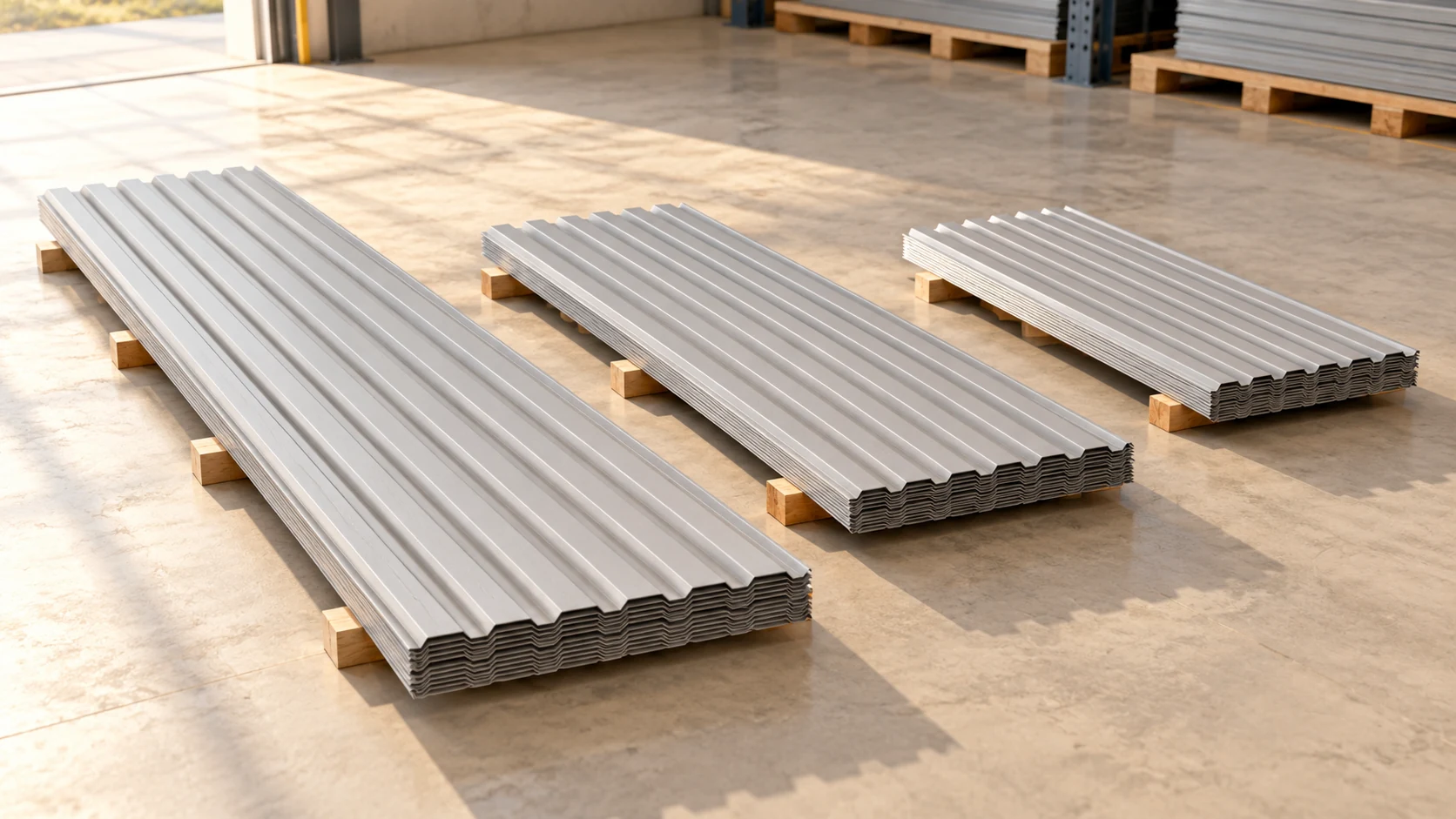
What is a linear metre of sheet?
One hundred linear metres could mean twenty 5 m sheets. Their lengths add up to 100 m. To assess the order, you also need the width and roof layout. Twenty short runs cannot automatically replace ten long ones. End laps require their own detailing and an allowance for overlap.
How do gross sheet area and cover area differ?
Assume an overall width of 1.142 m and a cover width of 1.100 m. Twenty 5 m sheets give 114.2 m² gross but 110 m² of cover once their sides overlap. The 4.2 m² difference is used in the side laps and is unavailable as spare material.
The finished roof area can be smaller again. Allow for edge cuts, slope shape and any end laps. Adding the nominal cover of all sheets does not guarantee that they fit any roof of that area. Use a cutting plan to establish the actual requirement.
Why does the same unit rate produce different totals?
Assume a net rate of approximately €9.73 per unit, using the unrounded converted rate for the totals. Charged per linear metre, the 100 m order costs €973.24 net. Charged per square metre of cover, 110 m² costs €1,070.56 net. Based on gross sheet area, 114.2 m² costs €1,111.44 net.
The displayed unit price looks the same each time. Changing its unit changes the bill. This is a worked example. Ask the supplier to show quantity, unit, rate and line total so you can check the arithmetic directly.
Check the unit used for discounts too. A reduction per linear metre produces a different order saving from the same amount per square metre.
How do you prepare a sheet schedule for comparison?
List each length separately, with sheet count and cover width alongside it. Mark which roof slope will receive each group. Sheets of similar lengths can easily be mixed up on delivery or when lifted onto the roof. Simple drawing references reduce that risk.
Check whether sheets run from eaves to ridge in one piece. Otherwise account for end laps and their supports. Shortening sheets simply to meet a target number of metres can leave them unsuitable for the structure. The shape and position of each run must suit the roof and its installation method.
Check delivered lengths group by group. Two swapped items can give the same total length yet fail to fit the intended slopes. A sheet schedule showing the location of each item makes this discrepancy visible.
What does the price of the hundred metres exclude?
Check flashings, fasteners, seals and transport separately. Unloading, lifting equipment and installation may also be extra. Quotations vary. Even if someone calls it a “complete roof”, establish in writing which items are included.
On a small order, fixed costs make up a larger share per square metre. For example, a delivery costing €139.03 on 100 m² adds about €1.39/m². If missing flashings require another journey, the discount on the sheets can quickly disappear.
How do you avoid misunderstandings when approving the quote?
Write out the billing unit and total value on the order confirmation. Check that all items use the same tax basis. Agree the profile, thickness, coating, colour and which face receives the finish. Equal quantities can still describe products for different applications.
Sign off the sheet schedule and drawing together before production. Compare the delivered packs with that document. It is easier to identify a missing sheet than to argue about “a hundred metres”. This matters especially for sheets made to agreed lengths.
Questions and answers
Do 100 linear metres equal 100 m²?
Only if the relevant width is exactly 1 m. For any other width, multiply the length by the applicable width.
Can I order 100 m² without listing individual sheets?
An initial estimate is possible, but production needs sheet lengths and counts. Base the cutting plan on the measured roof dimensions.

Free quote
What to include in your enquiry
Tell us how you plan to use the material, the dimensions and the quantity you need. Include the thickness, grade or variant name, along with the delivery town or your preferred collection branch. For a specific product, add its name or a link to the product page. We will reply to the email address you provide to discuss availability and the terms of your order.
Read next
Steel cladding offers a light covering for a wall, dry installation, a choice of rib patterns, a factory finish and the option…
Reviews can help you decide what to ask before ordering panels or sheet metal. You still need to check the quotation and…
Sheet format affects how a roof is delivered and installed. A long sheet can cover an uninterrupted strip of slope, whereas small…
Two roofers can quote different prices per square metre for the same slope because they are pricing different work. One may include…
Plan for snow before the roof disappears under it. Give the contractor a drawing showing rooflights, changes in level, drainage outlets and…
Metal roof tiles suit a new roof when the permitted pitch, supporting layers and installation method match the design. Before comparing prices,…
A single panel running from ridge to eaves can eliminate an end lap and the support and sealing detail it would otherwise…
Look at the whole elevation before choosing a metal roof from a sample. Shallow trapezoidal ribs cast fine shadows; a deeper profile…