How to choose insulation for a hollow clay block wall
PIR insulation
At a glance
Block thickness alone cannot determine insulation thickness. You need the properties of the masonry, mortar, ring beams and intended finish. With PIR, distinguish a render-compatible board from a foil-faced one. Start with the thermal target and space around windows before comparing stock thicknesses. Identify the clay blocks and how they were laid: the conductivity of one block does not necessarily describe the finished wall. Joints, mortar, direction of heat flow and assumed moisture content matter. For a new house consult the records; older masonry may need inspection.
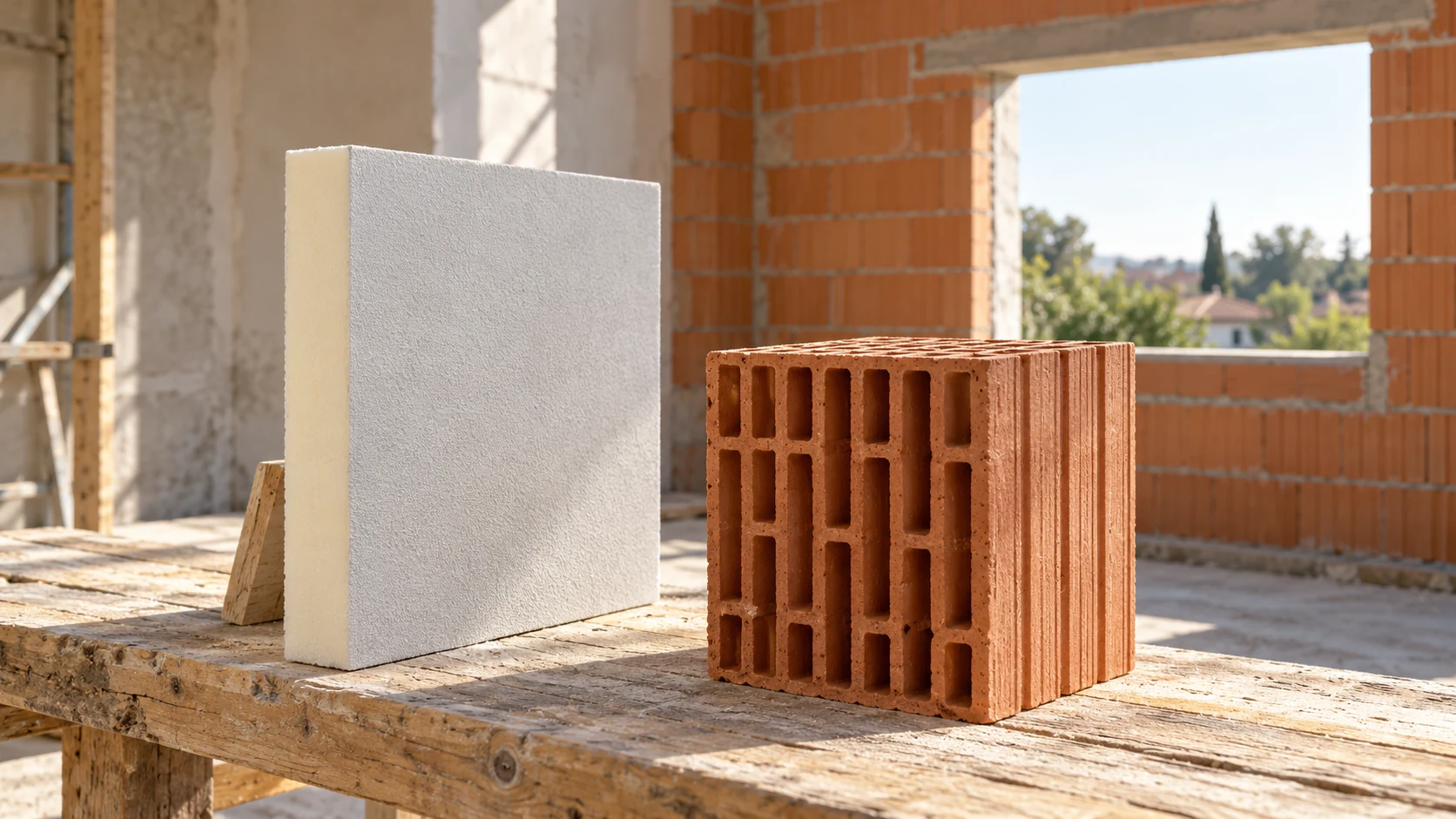
Identify the masonry and its joints
Separate the clay block areas from reinforced concrete ring beams, columns and lintels. Using one favourable conductivity for the entire elevation masks greater heat flows elsewhere. Mark service chases and repairs. For unknown old materials the designer needs a justified design value.
Set the target for the finished wall
Set a U-value appropriate to the project and building use. Calculate the thermal resistance of the existing layers, including finishes. For a simple comparison use R = d/λ, with thickness d in metres and conductivity for the specific material.
Suppose the masonry and surface resistances total 1.45 m²K/W. For U = 0.20 W/(m²K), total resistance must reach 5.00 m²K/W, leaving 3.55 m²K/W for insulation. This is a simplified wall-field calculation; assess fixings, non-uniform areas and junction bridges separately.
Calculate two viable options
At 3.55 m²K/W and λ = 0.026 W/(mK), the calculation gives about 92 mm. Check stock sizes and data for the actual board. If selecting 100 mm, recalculate; conductivity may itself vary with thickness.
Foil-faced and render-grade boards may have different conductivities. A thinner calculated foil-faced board cannot simply be bonded into any façade system. Compare complete systems with a confirmed application, including fixing method and outer finish.
Detail windows, sills and plinths
Draw a reveal section before ordering. Connect the insulation to adjacent layers without leaving an unintended gap at the frame. Allow for shutter guides, sill, drip edge and corner finish. Field thickness alone does not define junction quality.
Check plinth and roof transitions too. Moving the façade line outward can require new flashings or gutter adjustments. Thinner insulation helps with shallow projections but does not replace a drainage detail. A wet termination can undermine thermal performance.
Choose a complete render system
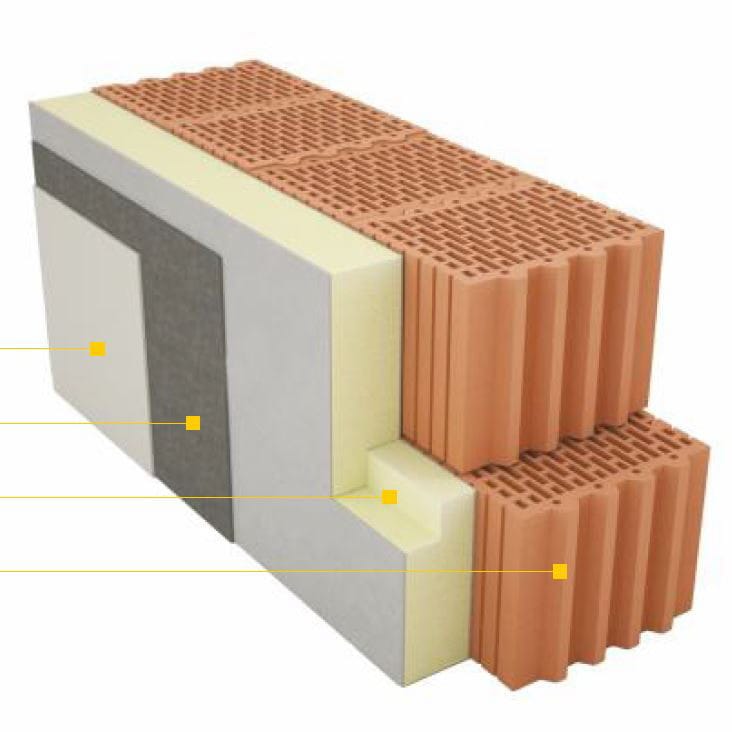
Insulation, adhesive, fasteners, reinforced base coat and render must belong to the intended assembly. Use a suitable facing and check which side goes out. Applying an arbitrary primer to smooth aluminium foil does not turn it into a render carrier.
Select anchors for block type, actual substrate and loads in each façade zone. Do not copy dowel spacing from another site. If capacity is uncertain, on-site testing may be needed. Check the masonry is prepared, dry and protected from runoff before bonding.
Drilling technique matters in hollow blocks. Follow the selected anchor instructions for that substrate. Damaging a thin internal web can weaken anchorage even with a correctly sized dowel.
Prepare the order schedule
List wall fields, reveals and plinth areas separately. Include thicknesses, edge profiles, facing application and system components. Derive waste from the cutting layout: many openings can require more cuts than a larger uninterrupted wall.
Compare quotations with identical scope. Omitted anchors, trims or window details alter the total. On delivery check variant markings and edge condition. Approve substitutes within the complete system and repeat the thermal calculation even when thickness is unchanged.
Questions and answers
Can I choose insulation from block thickness alone?
No. You need the masonry properties, mortar, target U-value and thermal bridge details. Two walls of equal thickness may need different insulation.
Can any render be applied directly to foil-faced PIR?
No. Choose a board and complete system intended for the rendered façade. Facing type and component compatibility are part of the selection.

Free quote
What to include in your enquiry
Tell us how you plan to use the material, the dimensions and the quantity you need. Include the thickness, grade or variant name, along with the delivery town or your preferred collection branch. For a specific product, add its name or a link to the product page. We will reply to the email address you provide to discuss availability and the terms of your order.
Read next
PIR insulation can reduce heat loss through the treated building element, but it does not set the heating controls for you. After…
Harvest sets the deadline for work on a potato store. Allow time to assess the building, order materials, install them and test…
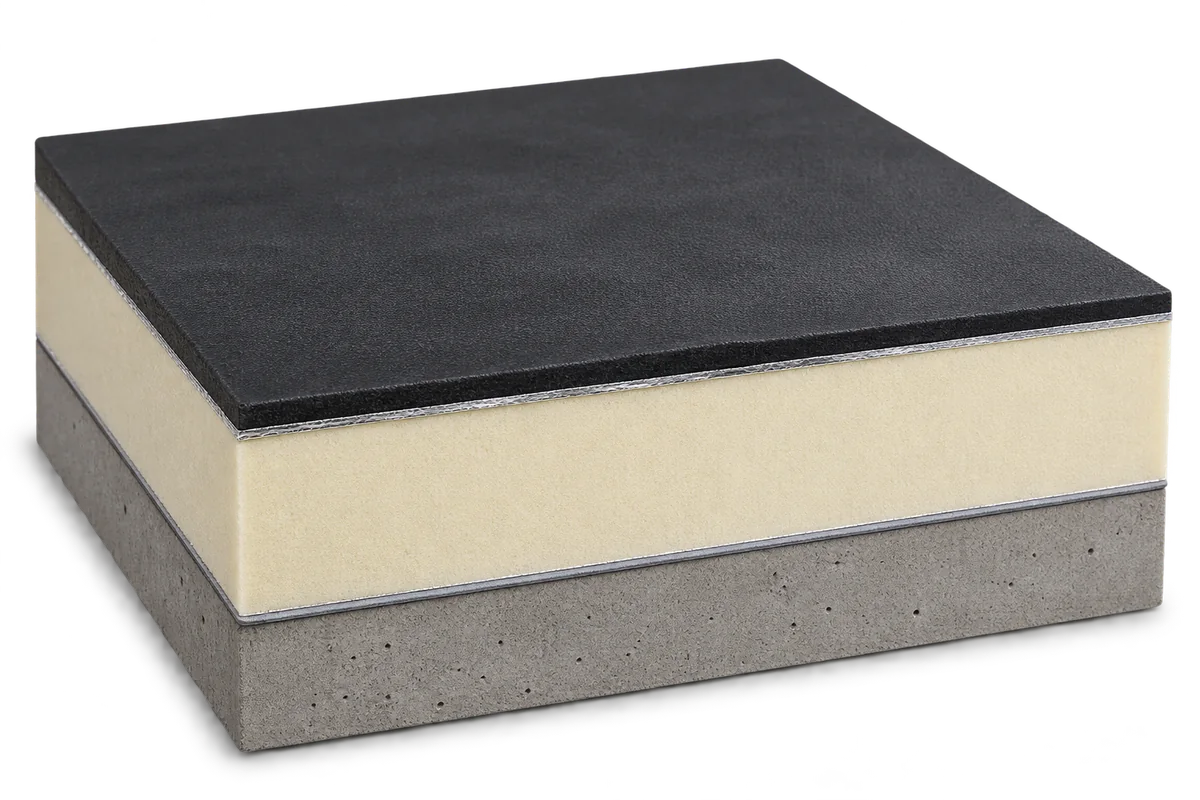
Choose the waterproofing and insulation for a flat roof together. The deck, layer order, fixing method and intended use determine which combinations…
A timber house for year-round use must meet the requirements for a dwelling. In Poland, using timber does not in itself determine…
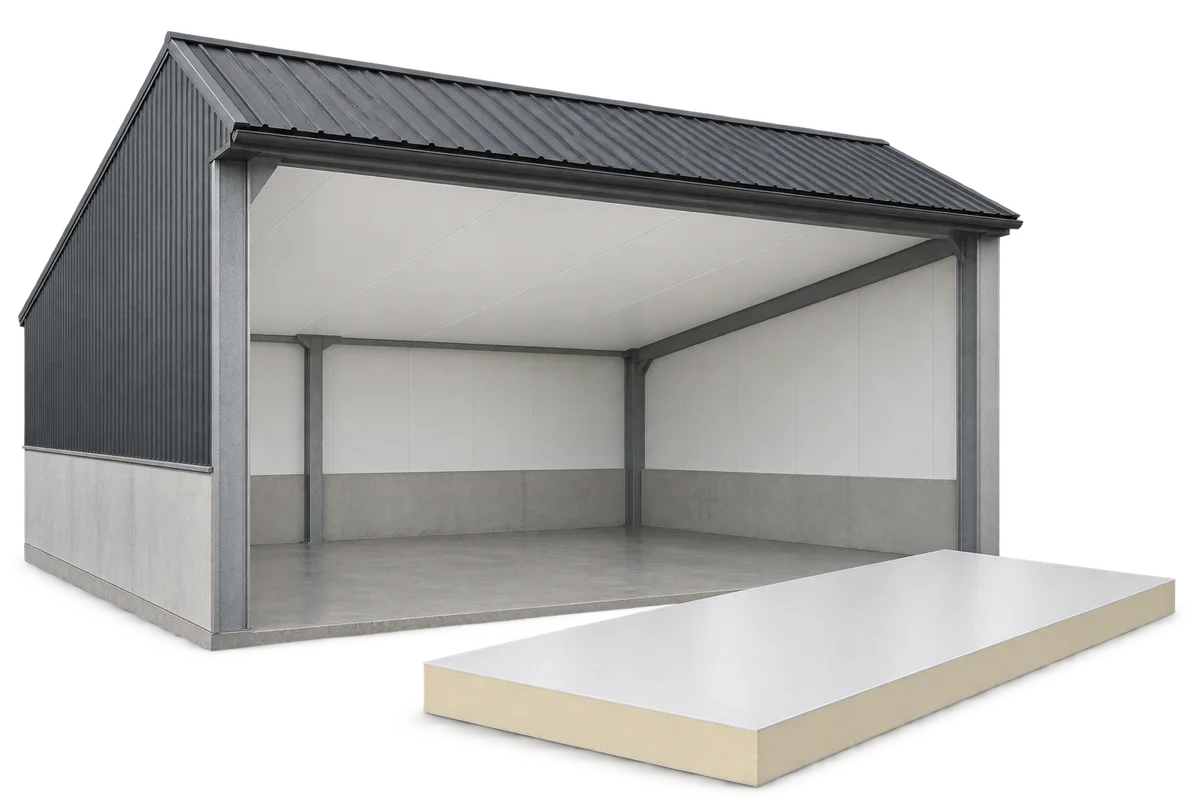
An internal ceiling can separate a heated or climate-controlled room from the roof void. In a cattle shed or warehouse, its appearance…
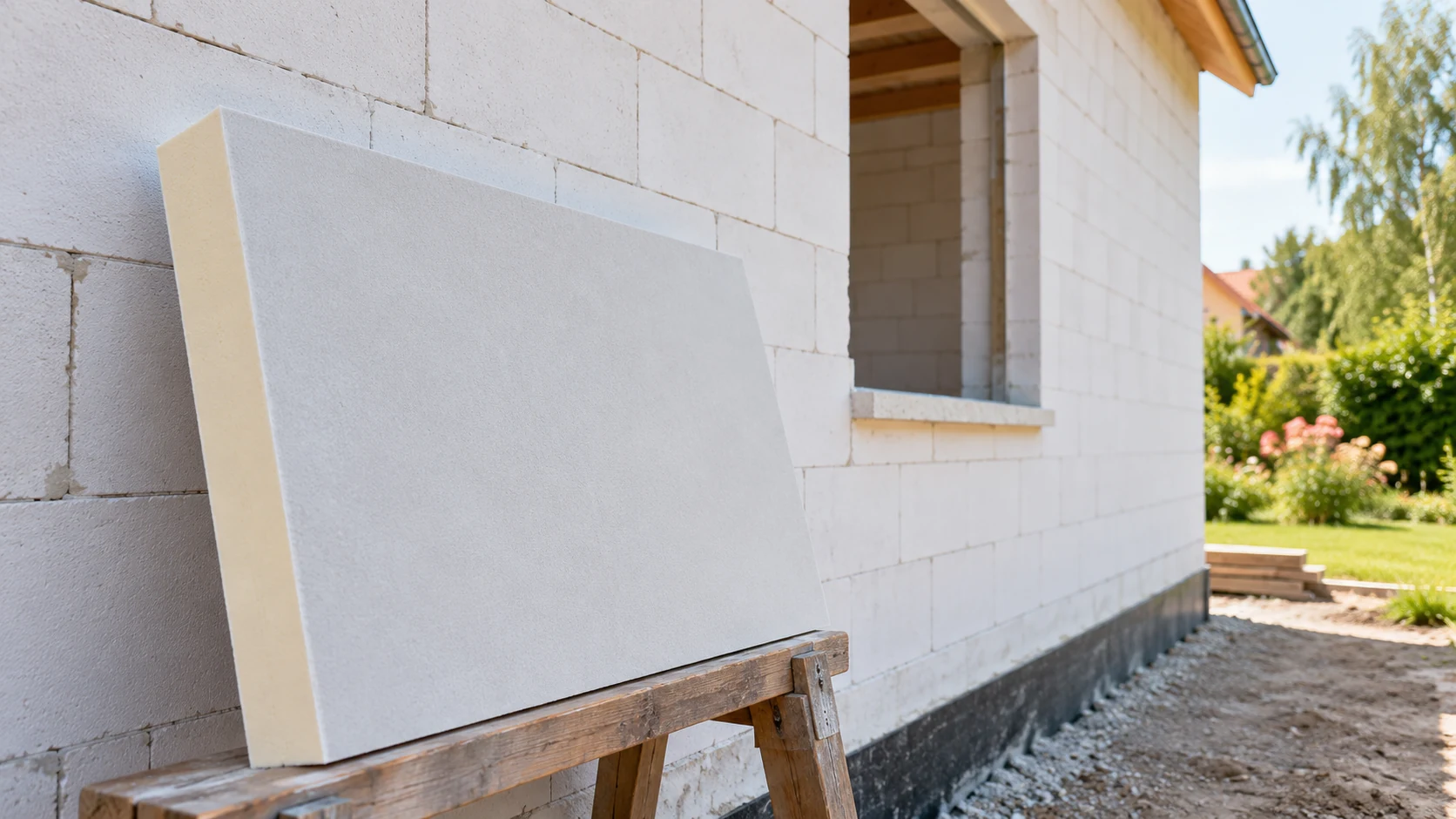
Aerated concrete masonry and PIR can make a well-insulated wall when the board, render system and fixings are selected together. Aluminium-faced PIR…
Intermittent use makes warm-up time, moisture on arrival and running costs between visits especially important. It calls for a different plan from…
At a house viewing, the seller shows an invoice for PIR boards and photographs of a renovation. To connect these records to…