






How do U-values and thermal conductivity relate to heat loss through a mineral wool panel?
Mineral wool panels
At a glance
Thermal conductivity (lambda) describes the material; the U-value describes heat transfer through a specified element. When buying mineral wool wall panels, use the data for the complete variant to estimate heat loss through the panel area. That estimate is neither a building heat balance nor an annual heating bill. Lambda is expressed in W/(mK). A lower value means less heat flow at the same material thickness and temperature difference. One example dual-density wool core has a conductivity of about 0.039 W/(mK). Do not assume that this figure applies to every mineral wool panel core.
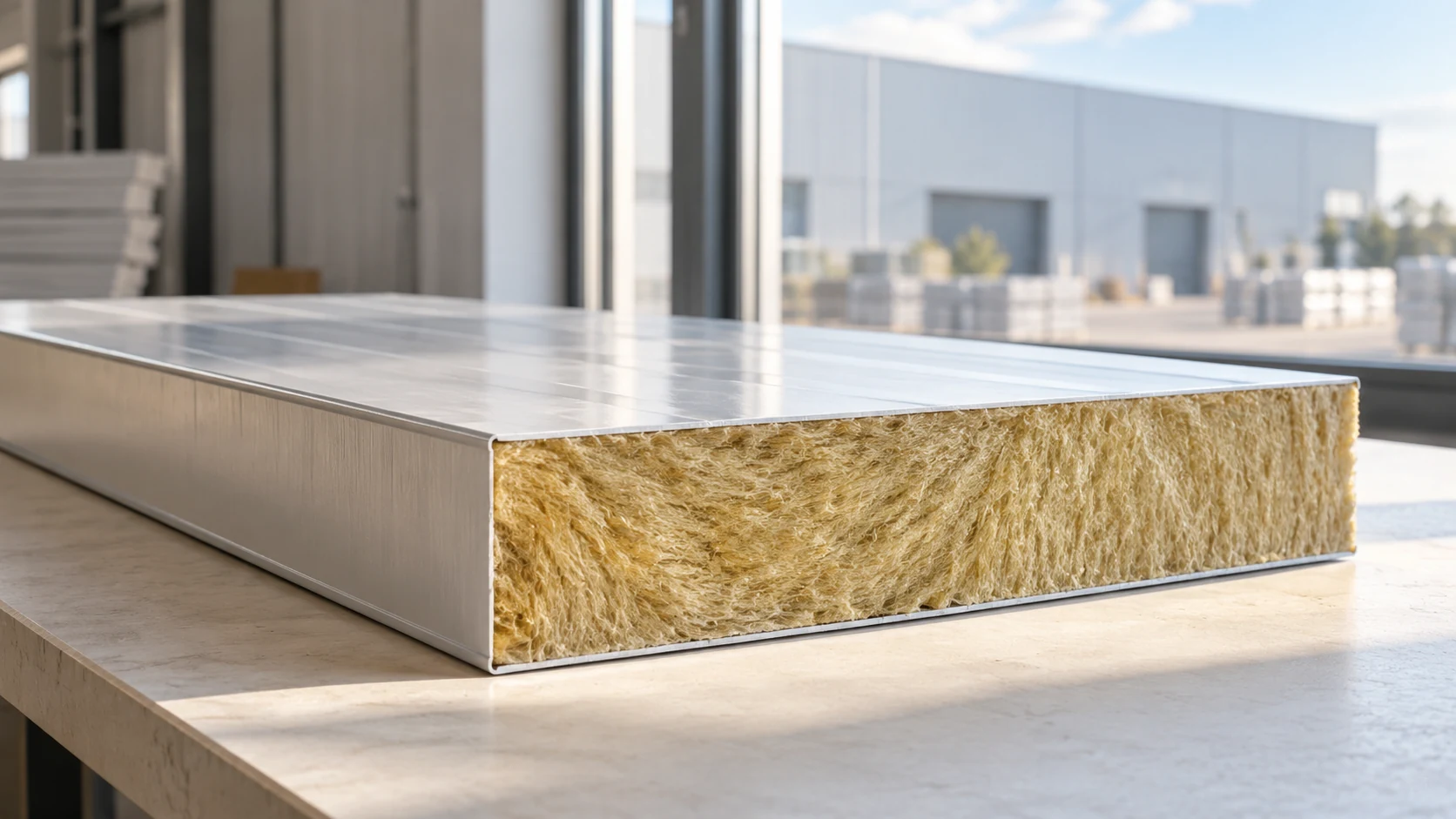
Lambda describes the core material
Thickness divided by conductivity gives the thermal resistance of a homogeneous layer. This explains the trend, but a finished panel has joints and a particular geometry. If a declared U-value is available for the complete element, use it in the order rather than deriving one solely from the core.
The U-value belongs to a specific panel
The U-value, in W/(m²K), relates heat flow to area and temperature difference. Check whether the data sheet gives the value for the panel field or a corrected value for the product. Compare figures determined by the same method for the actual variants on order.
In one wall panel range, 120 mm gives 0.31 W/(m²K) and 180 mm gives 0.21 W/(m²K). Both have the same core design but different thicknesses. Other systems can differ because of the joint, geometry and the way joints are accounted for.
Compare two thicknesses on the same wall
Take 324 m² of panel area and a temperature difference of 26 K. Heat loss rate through that area is estimated as Q = U × A × temperature difference. At U = 0.31 this gives 2,611.44 W, or about 2.61 kW. At 0.21 it gives 1,769.04 W, or about 1.77 kW.
The difference is about 0.84 kW under these conditions. This is the effect of increasing the thickness of this wall area, not a corresponding reduction in the whole building’s heating capacity. The calculation assumes steady temperatures on both sides and excludes doors, ventilation, roof and other elements.
Use the same area for both variants. If one calculation includes windows and the other omits them, geometry affects the result too. Here the 324 m² refers solely to the panel area under consideration. Recording this makes the calculation reproducible.
Include losses beyond the panel area
Real walls have edges, corners, plinths, reveals and fixings. The designer assesses their effect on heat loss and surface temperatures. Avoid counting effects already included in the declared U-value a second time. Use a consistent method for the whole envelope.
A large, poorly insulated vehicle door can change the result for the façade. Opening it often increases air exchange too. Compare each element’s share before paying extra for thicker panels. Improving a small area cannot resolve a dominant loss elsewhere.
Distinguish heat loss rate from annual energy use
Kilowatts describe power at a particular moment; annual energy use is measured in kilowatt-hours. Estimating it requires varying outdoor temperatures, heating hours, heat gains and system efficiency. Multiplying a cold-day heat loss by every hour of the year gives a misleading answer.
Treat payback estimates just as carefully. Energy prices and use patterns change. A warehouse heated only during working hours differs from one maintained at temperature around the clock. State the operating scenario instead of promising a single payback date.
Record the assumptions behind each quotation
Record panel area, temperatures, operating hours and each variant’s U-value. Include changes to plinths, windows and flashings. Thicker panels may need longer fasteners or revised details; these belong in the cost comparison.
Start with any thermal performance specified by the design. Then check fire, mechanical and environmental properties. A low U-value is useful only if the panel can be installed correctly across the complete wall and suits the way the building operates.
Questions and answers
Can lambda alone determine panel thickness without a data sheet?
It can estimate core resistance but cannot confirm the finished panel’s properties. Selection needs product-specific data, joint geometry and the requirements for the whole wall.
Is a 26 K temperature difference the same as 26°C?
Yes, a difference of 26 kelvins is numerically the same as a difference of 26 degrees Celsius. The heat-loss equation uses the difference between two temperatures, not the room temperature alone.

Free quote
What to include in your enquiry
Tell us how you plan to use the material, the dimensions and the quantity you need. Include the thickness, grade or variant name, along with the delivery town or your preferred collection branch. For a specific product, add its name or a link to the product page. We will reply to the email address you provide to discuss availability and the terms of your order.
Read next
A2-s1,d0 describes the reaction to fire of the finished panel. It is not the wall’s EI fire resistance rating. The mineral wool…
A mineral wool acoustic sandwich panel can enclose a building and absorb sound on its inner face. A perforated facing distinguishes this…
Clearance mineral wool panels can cut the cost of a wall if the batch fits the project. Usable lengths, intact joints and…

There is no single service life in years for a mineral wool panel wall. A sheltered warehouse, a vehicle wash and a…
Inspect the frame before installing mineral wool wall panels. Fixings cannot compensate for crooked rails, a missing support at an opening or…
A mineral wool wall panel can form an external enclosure or an internal partition. Choose it where the properties of a specific…
Choose the core for the job the wall or roof must do. Mineral wool and PIR offer different combinations of insulation, weight…
A mineral wool core alone cannot guarantee a quiet hall. First locate the source and the point that needs protection: a machine…
