






What should you check before anchoring a steel hall to an existing foundation?
Installation and inspection
At a glance
A finished foundation is not, by itself, clearance to drill the column anchors. First confirm the geometry, the concrete properties and the connection design. A bonded anchor is one part of a connection that transfers loads from the hall into the foundation. Depending on the design, the column base may carry compression, shear, tension and bending moments in combination. Neither the column weight nor the hole diameter in the base plate tells you which anchor to use. The following checks cover preparation and acceptance; the instructions for the specified system still govern installation.
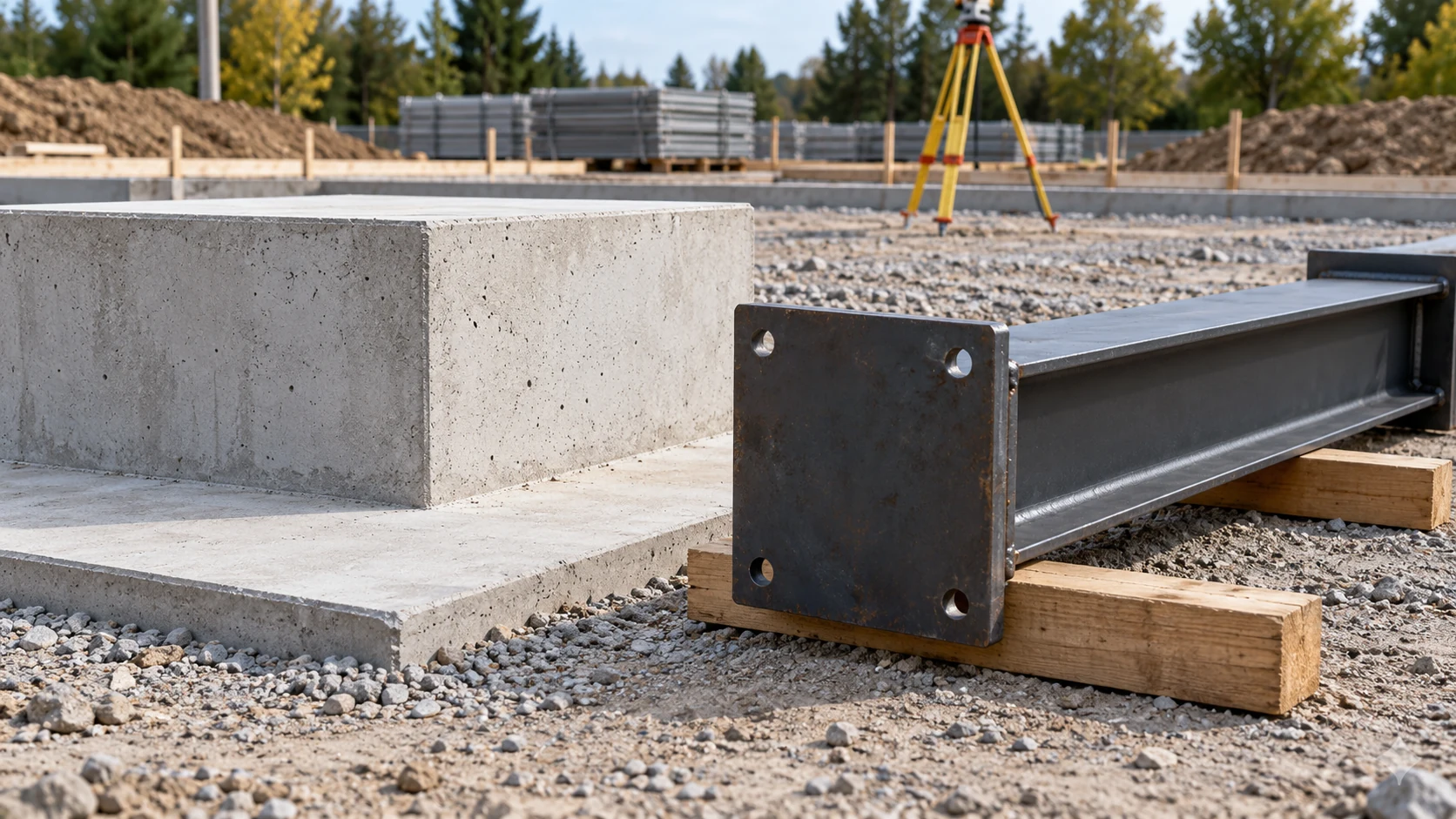
Which forces must the column base transfer?
The design should specify the anchor layout and load path. Check the base plate, welds, bearing and foundation too. A larger rod diameter is not a universal remedy: it may change edge distances and how anchors act as a group. Refer changes to the connection designer.
What do you need to know about the existing concrete?
Establish the concrete strength class and condition, foundation dimensions, reinforcement positions and the cracked or uncracked condition assumed in design. An apparently sound surface may conceal voids or unknown layers. Resolve uncertainty by investigation and assessment, not extra resin.
Set out the axes and measure actual edge distances before drilling. Locate reinforcement to avoid clashes. If a hole meets a bar, do not move it a few centimetres on site: that changes the connection geometry. Agree a solution and update the installation drawings.
What makes an anchoring system compatible?
The system comprises the mortar, rod or other anchoring element and specified accessories. Its documentation identifies permissible substrates and conditions. A rod of similar diameter does not make an arbitrary resin-and-rod combination suitable: the approval relates to the complete configuration.
Check shelf life, storage conditions and packaging. Confirm that the drilling method and hole moisture are allowed by the assessment and instructions. A figure from a general table is not the capacity of a finished column base; anchor group effects and foundation edges matter.
Why inspect the drilled hole before injecting mortar?
Hole diameter, depth and drilling method must match the design and system documents. Prepare the hole as specified after drilling. Dust or slurry can reduce bond in many systems; use the sequence, tools and cleaning repetitions specified for this anchor.
Other systems have different requirements. Verify the procedure actually used and record the measured depth and hole condition before injecting mortar. Once the work is covered, the exposed rod tells you little about the hole beneath it.
When can the anchor be tightened and loaded?
Installation and curing depend on substrate temperature and mortar type. Air and concrete temperatures may differ. Working time for fresh mortar is distinct from the time before loading is allowed; read both for the conditions at installation.
A hard-looking resin surface is not permission to proceed. Tighten, set the base plate and apply loads according to the design and instructions. Maintain erection stability meanwhile. Curing anchors do not replace specified temporary supports or bracing.
What records should you retain at handover?
Keep a record that identifies the system, material batch, location, date, conditions and measurements required by the inspection plan. Record deviations and who approved them. A photo of a finished nut proves neither hole preparation nor curing time.
Where site tests are required, define their scope and acceptance criteria in advance. A test cannot replace the design. After erection, inspect base plate bearing and corrosion protection as well. Design, materials and workmanship must refer to the same configuration.
Questions and answers
Can you move an anchor if the drill meets reinforcement?
Not without approval. Its position relative to the other anchors, the edge and the base plate changes. The connection designer should approve the solution.
Can erection of the whole hall start as soon as the resin sets?
Loading is permitted only when the system requirements and erection plan are met. The structure must also be stable at every stage.

Free quote
What to include in your enquiry
Tell us how you plan to use the material, the dimensions and the quantity you need. Include the thickness, grade or variant name, along with the delivery town or your preferred collection branch. For a specific product, add its name or a link to the product page. We will reply to the email address you provide to discuss availability and the terms of your order.




Read next

Two steel halls with the same floor area need not cost the same. A long, narrow building has more external wall than…
Start with what happens beneath the roof. An open shelter may need only a weather skin; a heated workshop needs a thermally…

Two cold rooms at the same temperature may need different enclosures. Door openings, humidity and incoming goods all affect the choice of…

A mineral wool core alone cannot guarantee a quiet hall. First locate the source and the point that needs protection: a machine…

The total price of a building tells you little about when you will need the money. Budget separately for site preparation, the…
